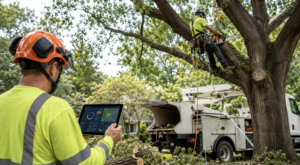
The public image of an arborist is still built around ropes, climbing gear, bucket trucks, chainsaws, and years of practical knowledge about trees. That image is accurate, but incomplete. Modern tree care companies also depend on smartphones, scheduling platforms, digital estimates, cloud storage, mapping systems, online reviews, electronic payments, and customer databases. The work may happen outdoors, but much of the business now runs through technology.
That shift matters because an arborist can be excellent at diagnosing tree disease, removing hazardous limbs, and protecting a property while still losing business through missed calls, scattered paperwork, weak cybersecurity, or outdated software. Technology does not replace field experience. It supports it. The companies that understand this are better positioned to respond quickly, document their work, communicate clearly, and build lasting trust with customers.
Information technology has become broad enough to include the systems used to create, store, exchange, and protect business information. The basic definition of information technology reaches far beyond office computers. For an arborist, IT can include everything from the phone used to photograph storm damage to the software that sends a proposal and records a customer’s approval.
Why Tree Care Has Become a Technology-Driven Business
Tree care is a physical service, but the customer journey is increasingly digital. A homeowner often begins by searching online, comparing websites, reading reviews, and checking whether a company appears established. The first interaction may be a contact form, a text message, or an online scheduling request rather than a phone conversation. By the time an arborist arrives at the property, the customer may already have formed an opinion based on the company’s digital presence.
This creates a practical challenge. Arborists must manage leads while crews are climbing, driving, hauling debris, operating equipment, and responding to urgent calls. Paper notes and memory are rarely enough once a company becomes busy. A request written on the back of a receipt can disappear. A voicemail can be forgotten. A photograph can remain trapped on one employee’s phone. A customer who expected a proposal on Tuesday may still be waiting on Friday.
A connected IT system reduces those gaps. Customer information can move from the first inquiry to the estimate, work order, invoice, and follow-up without being retyped several times. Office staff can see what happened in the field, and field crews can see what was promised to the customer. That continuity creates a more dependable experience without forcing the arborist to spend every evening sorting through messages.
Cloud Software Keeps the Office Close to the Jobsite
Cloud software is especially useful for businesses that rarely operate from one fixed location. An arborist may begin the morning at a residential property, inspect storm damage at a commercial site before lunch, and finish the day reviewing tomorrow’s route from home. Cloud-based systems allow authorized employees to reach current information from different devices and locations.
As explained in IBM’s overview of cloud computing, cloud services provide access to computing resources, applications, and data through the internet instead of limiting everything to a single local machine. That model fits tree care because the people who need the information are often spread across trucks, jobsites, and offices.
Cloud storage can also provide a central home for contracts, insurance documents, safety forms, inspection photographs, equipment records, and job notes. When files are organized properly, an arborist can retrieve a past proposal or property photo without searching through an old laptop or a stack of folders. Shared calendars and documents also help office staff, estimators, and crew leaders work from the same information. Google describes its small-business tools as supporting business email, video meetings, cloud storage, file sharing, and shared calendars through Google Workspace.
The value is not simply convenience. Better access to information can prevent duplicated visits, incorrect addresses, missing gate codes, and misunderstandings about the approved scope of work. When a customer calls for an update, the person answering can see the job status rather than guessing or promising a callback that may take hours.
Scheduling, Routing, and Digital Estimates Improve Daily Operations
The distance between profitable work and an exhausting day can be measured in drive time. Poor routing sends trucks across town repeatedly, creates late arrivals, and adds fuel and labor costs. Scheduling software can group work by location, job type, equipment needs, crew availability, and urgency. It can also leave room for emergency calls after storms without turning the entire calendar into confusion.
Digital estimates provide another major advantage. An estimator can record tree species, condition, access limitations, equipment requirements, disposal needs, and recommended work while standing on the property. Photographs can be attached to the customer record, reducing the chance that a crew arrives without understanding the site. The proposal can then be delivered electronically instead of waiting for paperwork to return to the office.
This also improves consistency. A company can build templates for pruning, removals, stump grinding, cabling, inspections, and plant health care. The language remains clear while the details are adjusted for each property. Customers receive a professional document that explains the scope, price, and terms in writing.
Reliable digital operations also support the company’s public visibility. A person searching for an Arborist Near Me is more likely to trust a business that responds promptly, provides clear information, and follows through. Search visibility may generate the opportunity, but organized technology helps turn that opportunity into a scheduled job and a satisfied customer.
Job Documentation Builds Credibility and Reduces Disputes
Arborists make recommendations involving safety, property protection, tree health, and long-term maintenance. Those recommendations are stronger when they are documented. A digital job file can include photographs taken before work begins, written observations, marked property maps, customer approvals, and images of the completed work.
Documentation protects both the customer and the company. It can show the original condition of a tree, confirm which limbs were approved for removal, and record obstacles such as fences, utility lines, landscape features, or restricted access. It can also preserve a history of previous visits, treatments, pruning cycles, and changes in tree condition.
This is particularly important when several people are involved. The person who inspects the property may not lead the crew. The homeowner who requests the work may not be present when it is completed. A property manager may need to report to an owner or board. Clear records keep everyone aligned and reduce reliance on verbal explanations passed from one person to another.
Digital documentation also strengthens future service. When a customer calls two years later, the arborist can review the prior work instead of starting from zero. That history supports more informed recommendations and shows the customer that the company treats the property relationship seriously.
Cybersecurity Is Now Part of Protecting the Business
Every digital convenience creates a responsibility to protect the information involved. Arborist companies may hold customer names, addresses, gate instructions, email accounts, employee records, invoices, banking details, and payment information. They may also depend on software for scheduling and communication. Losing access to those systems during a busy storm response could disrupt the entire operation.
The NIST Cybersecurity Framework 2.0 provides guidance that organizations can use to manage cybersecurity risk. Its core approach includes governing risk, identifying assets and threats, protecting systems, detecting problems, responding to incidents, and recovering operations. Those ideas are relevant to a tree care company even when it has no internal IT department.
Basic protections should include unique passwords, multifactor authentication, automatic software updates, controlled access to company accounts, regular backups, and a clear process for removing access when an employee leaves. The Federal Trade Commission’s Cybersecurity for Small Business guidance emphasizes updates, backups, encryption, secure remote access, email authentication, and vendor security as practical areas of attention.
Small businesses are not too small to be targeted. The Cybersecurity and Infrastructure Security Agency maintains resources specifically for small and medium-sized organizations, including guidance related to ransomware, cloud security, backups, and risk management.
Cybersecurity should not be treated as a single software purchase. It is an operating habit. Employees need to recognize suspicious messages, protect devices used in the field, avoid sharing passwords casually, and report mistakes quickly. A delayed report can turn a small problem into a larger one.
The Right IT Support Prevents Technology From Becoming Another Burden
Many arborists do not need a full-time technology department. They do need reliable systems and someone who can keep those systems working. An IT provider can help choose appropriate software, secure email accounts, manage devices, organize backups, connect field and office operations, and create a recovery plan.
The goal is not to buy every available platform. Too many disconnected tools can create a new kind of disorder. Customer information may be stored in one app, photographs in another, invoices in a third, and passwords in someone’s notebook. A better approach starts with the actual workflow of the company and selects technology that supports it.
Small-business cloud platforms can scale without requiring a company to maintain its own server room. AWS describes cloud hosting for small and medium businesses as a way to avoid overprovisioning while supporting changing business needs. Microsoft similarly recommends that small businesses begin digital transformation with a long-term strategy tied to measurable business outcomes rather than adopting technology without a clear purpose.
For an arborist, measurable outcomes may include faster response times, fewer missed appointments, shorter invoice cycles, improved route efficiency, better recordkeeping, or more repeat work. Technology earns its place when it reduces friction and helps the company deliver better service.
IT Helps Arborists Prepare for Growth and Emergencies
Tree care demand can change quickly. A severe storm may produce a surge of calls overnight. A growing company may add crews, trucks, service areas, and office staff in a short period. Systems that worked for one owner and a helper may fail when ten people need access to the same information.
A solid IT foundation makes growth more manageable. New employees can receive company email accounts, access the right files, follow standard estimate templates, and use shared scheduling systems. Managers can review job progress without calling every crew. Customer history remains with the company rather than living in the memory or phone of one employee.
Emergency preparation matters just as much. A company should know how it will operate if a laptop fails, a phone is lost, internet service is interrupted, or a business account is compromised. Backups, recovery procedures, alternate communication methods, and updated contact lists allow the business to continue working when conditions are already stressful.
Good IT planning creates resilience. It gives the arborist more control during the moments when customers need fast answers and dependable service.
Conclusion
Chainsaws, ropes, lifts, and climbing skill will always remain central to professional tree care. Technology does not change the physical realities of the work, and it cannot replace the judgment of an experienced arborist. It does, however, influence nearly everything surrounding the work.
Cloud software keeps records available across locations. Scheduling and routing tools make better use of crews and equipment. Digital estimates create a clearer customer experience. Job photographs and organized files strengthen documentation. Cybersecurity protects the information and systems the company depends on. Reliable IT support connects those pieces so they serve the business instead of slowing it down.
The modern arborist is not leaving traditional skills behind. The profession is adding new tools to the truck. Companies that combine field expertise with organized, secure technology can respond faster, communicate better, protect their reputation, and build a business prepared for the next customer, the next crew, and the next storm.
